Fall detection: the SOS goes out on its own when the wearer cannot press it
An emergency button works as long as you are conscious and have a free hand. The watch detects the impact, asks if you are OK and, if there is no reply within twenty seconds, calls for help on its own, to your control room, and sounds on your wrist so that whoever comes to find you can locate you.
SOS to control room in <2 s with signalautomatic at 20 s
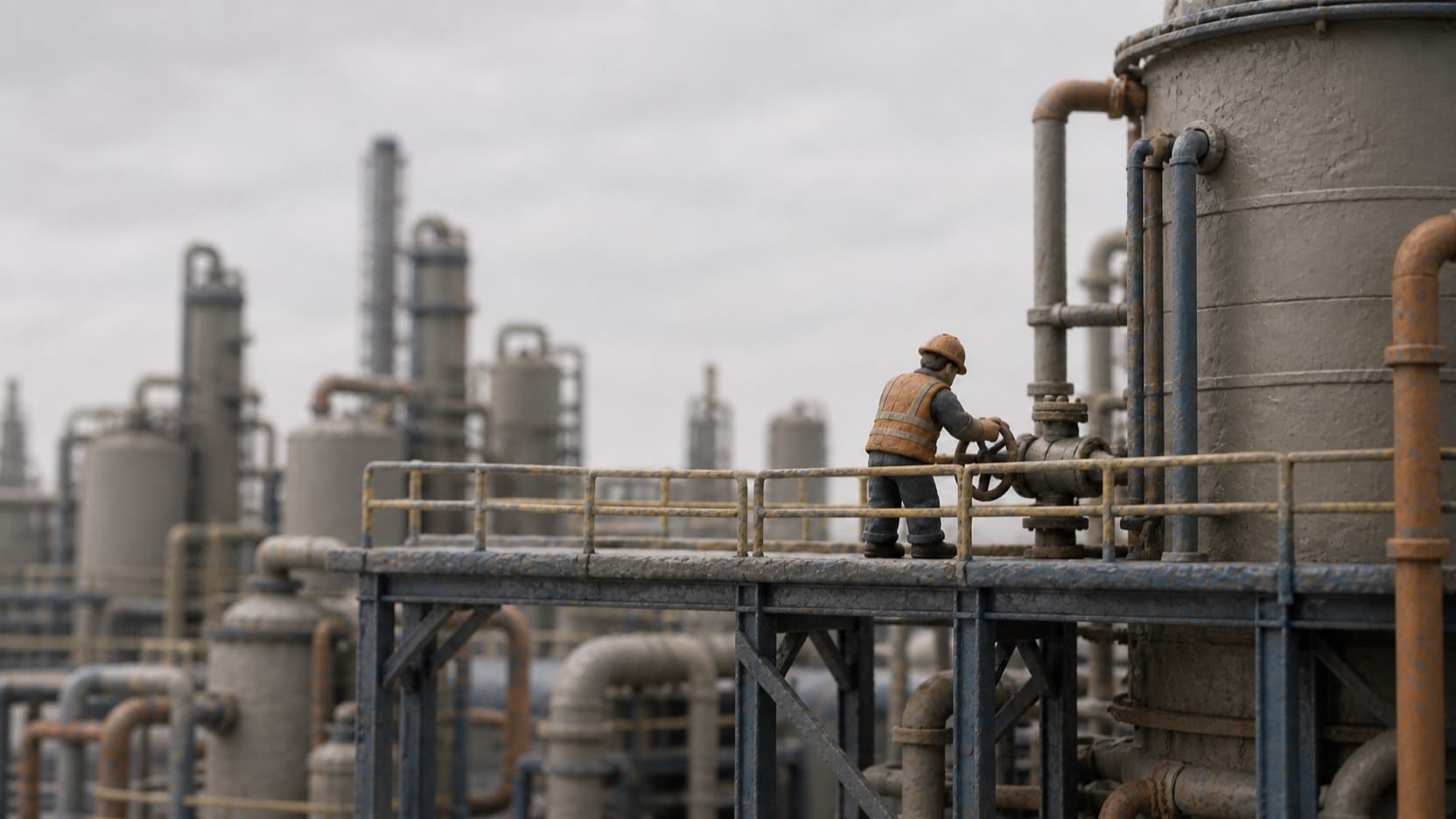
What fails isn’t the alert. It’s that nobody raises it.
Article 20 of Spain’s Occupational Risk Prevention Act (Law 31/1995) requires the employer to organise first aid and to make sure anyone in need can be alerted and attended to. In a large plant, with contractors spread out and people working alone in some corner, that rests on a chain of assumptions.
It is assumed that whoever falls can call for help. It is assumed that someone will pass by. It is assumed that, if they do not show up at handover, someone will notice and know where to look. In a fall with loss of consciousness, all three assumptions fail at once, and what is left is however long it takes for someone to wander past by chance.
A lone worker is not only someone on the night shift or a guard at a substation. It is anyone who, for twenty minutes, is somewhere no one else is: on top of a tank, in a chamber, at the back of a shed.
Twenty-two seconds, and none of them depends on the wearer
It is the device much of Spain calls “hombre muerto”, the dead man’s switch. The difference is in the approach: here fall detection is not the whole product, it is one of the rules on the watch they already wear.
T + 0 s
The impact
The watch’s accelerometer detects the fall. The worker does not have to do anything, and that is the part that matters: a button only works if the worker is conscious and has a hand free.
T + 1 s
The question
The watch vibrates and asks “Are you OK?” with a countdown on screen. If it was a trip, or the watch has knocked against a scaffold, it is cancelled there and nobody is disturbed.
T + 20 s
The silence
If there is no reply, the watch sends the SOS on its own. It is twenty seconds, not ten, because someone who has just fallen may be dazed, may have an arm trapped under their body, or may be wearing gloves. Not answering is, in itself, information.
T + 22 s
The protocol
The alert reaches the control room with name and position, and the on-site prevention officer (recurso preventivo) and the medical room are notified, according to your protocol. On the wrist, the watch starts to sound and vibrate, and does not stop.
Where the alert goes
Dead man’s switches sold in Spain send the alert to an alarm receiving centre, which phones the person. That works, and for a technician working alone at a remote installation it may be exactly what is needed.
In a plant with people inside, the person who can get there in two minutes is not at that centre; they are forty metres away, wearing the same watch. That is why here the alert goes to your control room, onto the plan of your plant.
And while the alert is open, the watch sends its position every three seconds, so what is shared is not “the last time we saw them was at the gatehouse at 07:00”: it is a dot on the plan that moves. While the alert is open, the team going to attend to them also sees their vital signs, and only theirs, only for as long as it lasts, with every access logged. So they set off knowing where to go and how the person is.
A dot on the plan stops being useful for the last ten metres. Inside a shed, behind a tank or in a chamber, whoever goes to find the wearer knows the place and cannot see them. So the watch sounds and vibrates while the emergency stays open, with its alarm volume turned up even if it was on silent. The beep is intermittent, not continuous, and that is deliberate: a steady tone is hard to place by ear and it also drowns out the voices of those searching. With pauses it can still be followed, and people can call out between beeps. After a few minutes it slows down but keeps sounding, because a rescue can take a while, and a beacon that runs out after twenty minutes stops sounding just when it is needed most.
The same watch that does this is the one that counts at the muster point, the one that warns about an off-limits zone and the one that interrupts for heat stress. It is not one more device to hand out: it is a watch that can save lives.
And what if there is no signal in that chamber?
Inside a pump house, behind a tank or in a cable basement, the network drops out. And the place where someone works alone is often exactly that, so here the question is not theoretical.
The watch does not discard the alert. It keeps it in its own memory and sends it as soon as the signal returns, even if it has to be restarted on the way.
An SOS, a fall or a heat alert is never dropped and goes first. What is dropped, if space runs out, are the old positions, which are a snapshot of a moment that has already passed. And every alert carries its own identifier, so retrying is safe: an SOS sent three times is still a single alert.
What we won’t tell you is that this works without signal. Without a network the control room receives nothing, and no manufacturer can fix that. What it can tell you is that this watch has gone five minutes without reporting in, and that alert closes itself when the signal returns.
For a lone worker, that is not a system fault. It is information. A silent watch in a chamber is exactly what needs checking.
EVENT LOG · LIVE
Watch without signal · J. Márquez has not reported for 5 min.
14:36 · last known position · chamber B-2
What this doesn’t do
There is no alarm receiving centre and no 24/7 service. SafeOnuba is not a private security company and does not provide that service, which in Spain is a regulated activity. The alert reaches your organisation; your own people respond, under your own protocol. If what you need is a centre that phones someone at 04:00, that is a different product, and it is better to say so before, not after.
No fall detector is right every time. A trip may trigger the question, and a gentle fall may not, which is why the button stays: automatic detection does not replace it, it covers for when the button cannot be used.
Wrist sensors are for alerting, not for diagnosing. This does not say what has happened to anyone, and it does not replace first aid or health surveillance.
For now it is deployed where there is no explosive atmosphere: building sites and assembly, workshops, warehouses, roads, open air. For classified areas, the route is ATEX zone 1/21 certified watches from specialist manufacturers, with the same Android system and the same app. The hardware changes; the software does not.
See it with your plant in front of you
In the mock-up you can trigger a fall and watch the whole sequence: the question on the watch, the twenty seconds, the SOS going out on its own and the protocol opening in the control room.