The roads in your plant have no pavement
The driver can’t see behind, and the person on foot is watching their work. Whoever gets into a vehicle declares it from their watch or phone and says which one, and from then on the person walking ahead is alerted on theirs before the driver can see them.
one radius per vehicle typealert on the pedestrian’s wrist
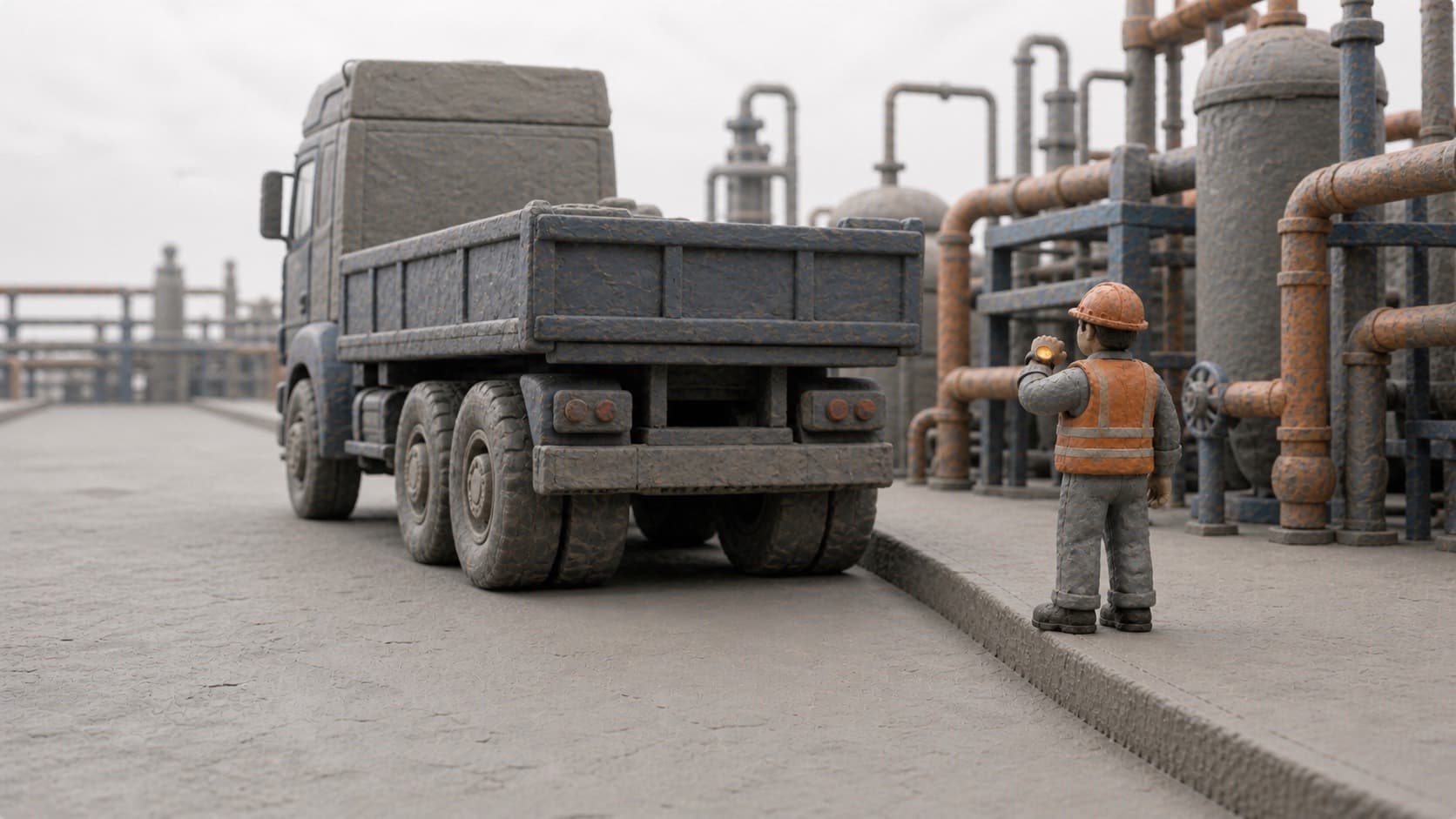
Fifty years of measures that depend on someone looking
The mirror, the beacon, the painted crossing and the hi-vis vest all work. None of them went in on a whim, and none is redundant.
What they have in common is that all four need a person, at one specific moment, to be looking in the right direction.
The driver can’t see behind, however careful they are
A reversing forklift has its mast in front of it and the load blocking half the view. An articulated truck has a blind spot that more mirrors won’t fix. It’s not carelessness on the driver’s part; it’s the machine.
The signage assumes you’re reading it
The painted crossing, the barrier and the road sign only work for someone who is looking at where they step. Anyone crossing with a load, talking on the radio or looking for a flange can’t see them, and they are exactly the same signs that have hung on the same wall for twenty years.
The hi-vis works by day, and at a distance
At twenty metres and in daylight, a hi-vis vest can be seen. At five metres, stepping out from behind a container, on a night shift or in the rain, the reflectivity comes too late. And the one who has to make use of it is the driver, not the person on foot.
And the shift change puts everyone on the road at once
The half hour of the shift change puts on the same roads the people walking out, the people walking in and the vehicles that use the lull to move material. It is the busiest stretch of the day and the least watched.
You set the radius, and it goes with each vehicle type
It isn’t a zone drawn on the map. It’s a distance that moves with the vehicle, so it covers the whole route, not just the places someone thought to mark.
You set up the vehicle types yourself in the app, each with its own radius. A forklift inside a warehouse and a tanker on an outdoor road don’t need the same number, and with a single radius one of the two was always wrong. The speed at which the system asks is edited in the same place, like the other six rules, without touching a single watch.
And on the control room map each type has its own icon. A truck and a forklift look nothing alike, and when they were the same dot on screen you had to open each one to see what was moving where.
They declare it themselves, and say which one
Whoever gets into a vehicle says so from their watch or phone with a tap, and picks from a list which one they are in: forklift, truck, telehandler or whatever you have set up. From that moment the system stops treating them as a pedestrian and applies the radius for that type of vehicle.
And if they forget, the system asks
If a watch starts moving at a speed other than walking pace, the server asks instead of taking it for granted, and if they say yes, which one they are in. Riding as a passenger on a trailer isn’t driving, and assuming it were would set off the watches of everyone it passes.
The server measures the distance
With each position that arrives, the rules engine checks where that vehicle is against where each person on foot is. No watch decides this on its own, just as no watch decides an SOS or a fall.
And it warns the person on foot, not the one inside
When the vehicle enters the radius, the pedestrian’s wrist vibrates, with the reason written out, and the alert goes to the control room, where the vehicle shows with the icon for its type and not as one more dot. Nothing distracts the person in the cab, because a driver looking at their watch would be a new problem.
Asking too often has a cost, so speed is filtered where it is measured. Tested on 258 real readings with the watch lying still on a table, the previous logic would have asked thirteen times and the current one not once.
What reaches them isn’t a beep
A beep could equally be a call, a message or a zone alert. In a noisy plant the worker would have to raise an arm and read, and on a road that is already too late.
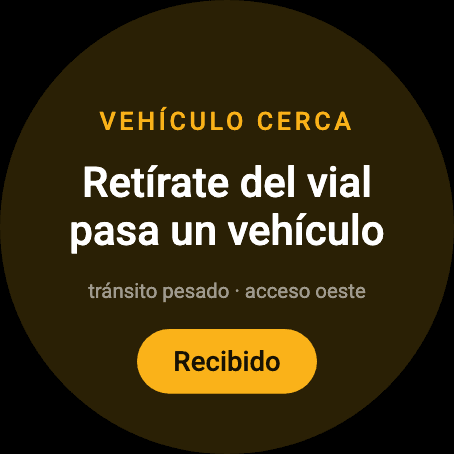
The vehicle alert has its own sound and its own vibration, different from those of a zone or a message from the control room. The wrist is a language, and two alerts that feel alike are worth less than one.
The screen shows what’s happening and what to do, with the reason underneath. And the worker taps “Got it”, so the control room has a record that the alert arrived, not just that it was sent.
The vibration is tied to the rule’s quiet period. Without it, every position reading while the truck passes would be another alert on the wrist, and a watch that buzzes non-stop ends up being ignored.
What this doesn’t do
It warns; it doesn’t brake. It isn’t a collision-avoidance system, it doesn’t act on the vehicle and it doesn’t take control away from anyone. What it does is let the person on foot know sooner, and the manoeuvre is still the driver’s.
It works with the position accuracy there is: outdoors, a few metres, and under cover, considerably worse. That’s why the radius is set per plant rather than fixed at the factory, and why it’s best adjusted with the road in front of you, not from an office. If what you need is accuracy to the centimetre inside a warehouse, that’s ultra-wideband radio: different hardware and a different project.
And it only sees vehicles whose driver carries a watch or a phone with the app. A haulier’s truck coming in to unload isn’t in the system, just as a one-hour visitor isn’t in the headcount. It’s the same condition as always, which is why devices are issued to the workforce and to the contractors who will be inside.
With the watch it is deployed where there is no explosive atmosphere. In classified areas the app runs on ATEX-certified phones, and the ATEX-certified watch is in development. The device changes, not the system.
Look at it with your plant in front of you
The mock-up has a scenario called “truck on the road”. You start it yourself and see both ends at once: the truck coming in through the west access on the map, and what shows up on the wrist of the person on foot.