From the alert to the incident report
Every alert records when it was detected, who took it on, what was done and when, where the worker was and where they went, and who looked at what. Nothing to rebuild afterwards, and nothing that depends on someone remembering.
until the watch saw ituntil acknowledgementuntil resolution
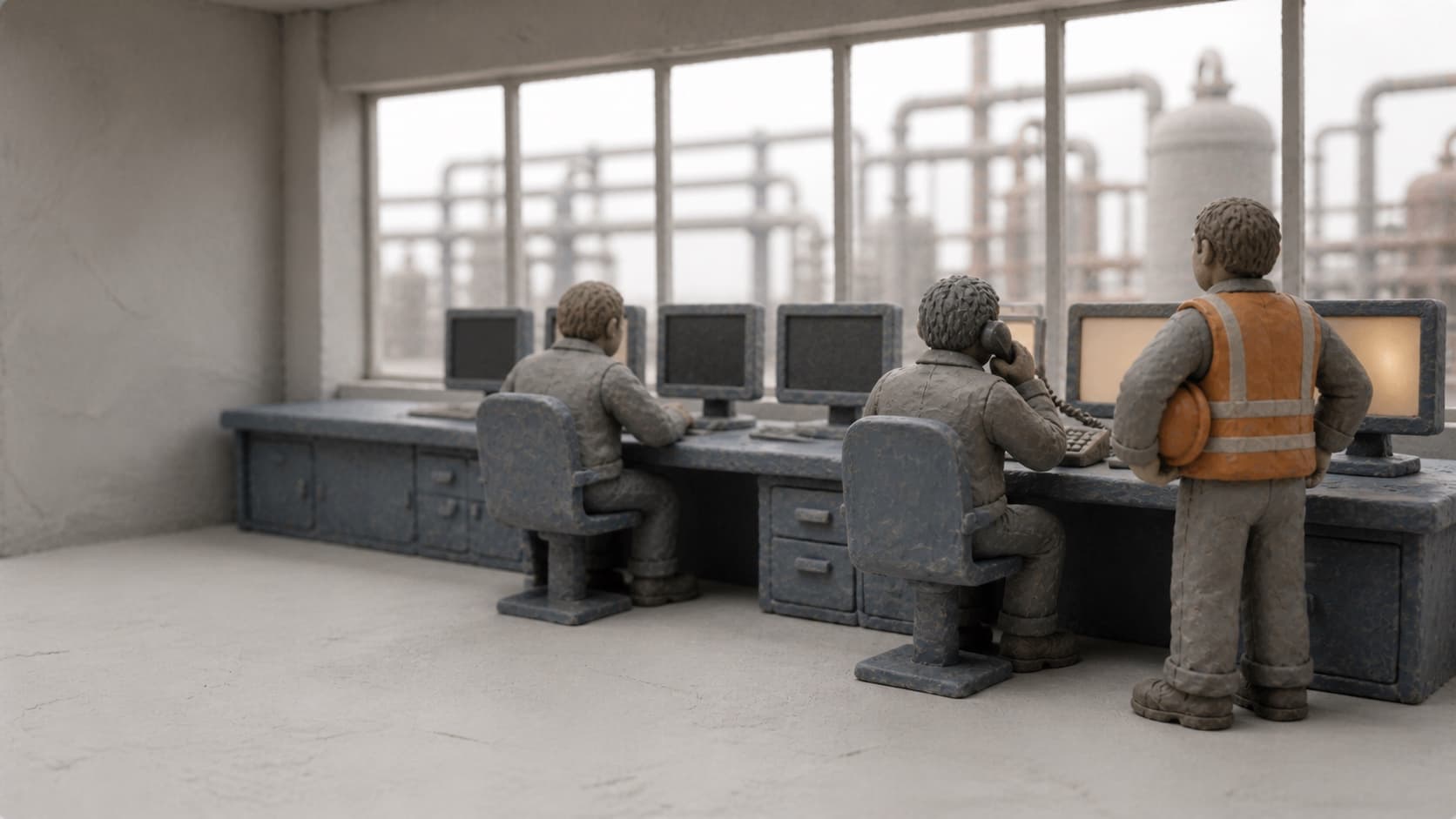
Nobody asks whether the watch detected it
That is taken for granted five minutes into the meeting. What gets asked afterwards, and what you need to be able to answer, is something else.
And it gets asked at the worst moment, when something has already happened and someone is standing there taking notes.
What time did the control room find out?
Not when it happened; the watch knows that. When someone was in front of the screen, saw it and took it on. Between the two times there is a gap, and that gap is what gets measured when a response is reviewed.
Who was handling it?
An open alert with no owner is one that everyone assumes someone else is watching. On a shift with three people in the room and fourteen alerts in the day, “I thought you had it” is not a small thing.
What was done, and in what order?
Someone called them, they didn’t answer, a team was sent, the medical unit was alerted, and their contractor was told. Each step with its time and the person who took it. Rebuilding that the next day by asking around is exactly where the details that matter get lost.
And why did that trigger?
Six months later, someone asks why the system opened a serious alert that Tuesday. The answer has to be the event that came in and the rule that assessed it, with the thresholds set that day, not anyone’s memory.
Where were they, and where did they go?
Today’s map cannot explain the one from that day. Where they were when it triggered, how accurately the GPS knew it, and where they moved while the alert was open are what answer why the team took as long as it did to find them.
Every alert has its record, and nobody has to build it
All of this was happening anyway. What changes is that it gets written down at the time, with its timestamp and its author, instead of being reconstructed the next day.
The times used to measure a response
How long it took someone to take it on, and how long the incident lasted from start to finish. These are the two numbers that turn “checking periodically that it works” into something you can show, and they are the same kind of data the evacuation page asks for in a drill.
And between the two, when the alert also goes to the wrist, whether the watch or the phone managed to confirm it. The control room finding out and the worker finding out are two different moments, and the record keeps them apart.
While nobody has acknowledged it, the alert says so in those words. A running clock nobody watches is worse than having none.
And eight ways of putting it on record
It is not a free-text box where each shift writes as it likes. Every action has its type, so afterwards you can count how many times a team was sent or how many ended as false alarms.
- Worker called
- Contractor notified
- Response team sent
- Medical attention
- False alarm
- Comment
- Assignment
- Status change
Where they were when it triggered, and where they went
The record keeps the point where they were when the alert fired, with the GPS accuracy at that moment next to it, and the route taken while the alert was open. You move through it with a time bar, and each action in the timeline is a mark on that bar.
A point without its error is a small lie
Next to “where they were” there is always the accuracy with which the GPS knew it at that moment: six metres, four, whatever it was. A team heading for a point has to know whether that point is a manhole or a building, and so does whoever reviews the incident afterwards.
Who was nearby, without drawing anyone
On critical alerts, the rule notes who was within a hundred metres according to their last reading, with the names from that moment. It keeps the distance, not where each person was, and anyone in a privacy zone is not counted, because their position is not recorded. It is the difference between knowing who could have been called and a plan with the whole workforce drawn on it.
How much is kept depends on how serious it was
Not every alert leaves the same trail, and the record says so below the map. For a warning, the route is cut off at the moment it opened: that is what is needed to understand what happened, and nothing more. For a critical alert it is kept in full, as evidence of the incident, because it is the material for the report, and deleting it would take away from the investigation the one thing that cannot be rebuilt.
And if it was a zone, how long they were inside
When the alert is for a zone, the record adds when they went in, when they came out, how long they stayed and whether they had a permit. Time inside is kept whether or not it was authorised, because half an hour in a zone with a permit is still exposure, and it is the figure the permits page promises to accumulate per person.
And who looked at the heart rate, which is the inspector’s question
During an emergency, the team going to help that person sees their vital signs. It is the only raw vital sign that comes off the wrist, and it is justified; but being justified does not remove the need to be able to say who looked at it.
It is logged by name, with the first and last look and how many times. And there is no second door: the dashboard cannot read that data by any other route, because a second door would turn the log into decoration.
And only for critical ones. For a warning, a zone entry or an expired permit, the watch doesn’t even switch on the heart-rate sensor, and the record says so in those words: it is one of the things that uses most battery, and the person who may be unconscious is the one who sets off an SOS or a fall, not the one who crossed a line.
It is the other side of the promise the rest of the website makes. There it is explained what the company does not see; here, that what it does see leaves a trail.
What is left when the alert closes
The heart-rate series is deleted on resolution, and that promise is not touched. What remains is a summary: how many readings there were, the range of values, the last one, and whether at any point the watch stopped touching skin. Without that, reviewing a closed incident would be working blind, and keeping the whole series would mean a health record lying around for no reason.
And each reading is already the median of a sample from the watch, not a single loose reading: the optical sensor gives wild values when the arm moves, and a spike that never happened is worse than no figure at all.
What this doesn’t do
It is not the official accident report. It is the timeline of the response. The investigation, the notification and the report that the regulations require remain the job of your health and safety service, and this is material for doing them, not a substitute.
Nothing classifies itself. Whether something was a false alarm is written by a person, and their name stays beside it. The system dates and orders, but it does not judge; a system that decided on its own that an alert was nothing would be exactly the one nobody should install.
It only records what goes through the dashboard. A radio call that nobody writes down still doesn’t exist. What this removes is the reconstruction of what was done through the dashboard, not the discipline of writing down what is done outside it.
See it with your plant in front of you
In the mock-up you can trigger a fall and watch the alert come into the control room. The full record, with the times, the route and the timeline, is what we show in the meeting with the real dashboard in front of you.